Real Time Intelligence (RTI) Lab Programme

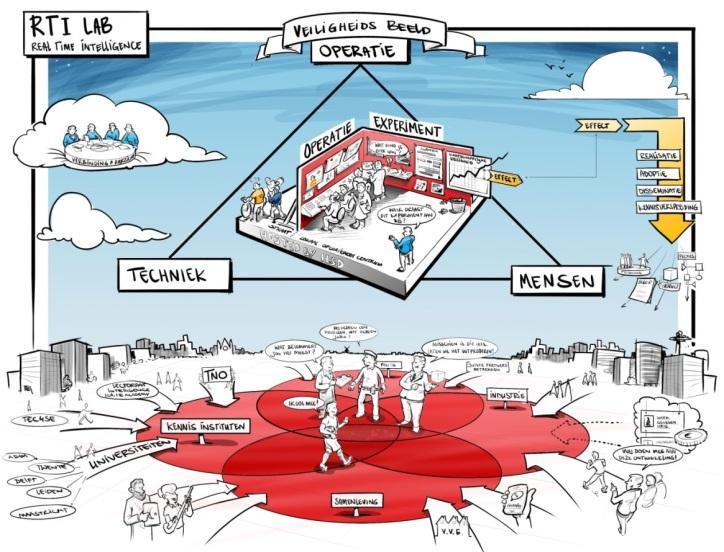
Processing real time intelligence -providing actual and relevant information at the right time- is key to security organisations. Real Time Intelligence (RTI) enhances the abillity of making operational decisions in real-time based on a wide range of field data. Streamlining data saves time, maximises efficiency, increases workforce productivity and enhances safety & security. It allows the optimisation of resources and investments made on infrastructures and generates value on any further investments and innovations. Strategic decisions based on real time intelligence also gives leverage and key competitive advantage; spotting critical issues and providing the right kind of tools for new business requirements. Watch the video to experience the concept of RTI.
Foundation for Innovation
RTI is especially valuable for police officers on the street, employees of the operational centre (emergency room) and analysts. That is why the Dutch National Police has appointed Real Time Intelligence as a starting point for their information process. To explore the needs and trends, the Dutch National Police, TNO and HSD launched the RTI lab programme in 2015. This programme has created the foundation of experimental innovation projects.
Ambition RTI Lab Programme
The RTI lab aims to showcase the added value of new products, services and concepts in the field of RTI and develop new applicable knowledge on Real Time Intelligence. The ambition is to become the knowledge centre in the Netherlands, where businesses, knowledge institutions and governments cooperate and share knowledge. To support this ambition, sinds 2016 HSD partners are welcome to join this initiative and participate in the further development of the RTI lab.
Results
Within the RTI programme a Trend Radar and a Experiments Roadmap have been developed. The Radar provides a top-32 of trends being relevant for RTI in the next few years. The roadmap contains an overview of RTI experiments and exposes the new concepts, methods and products from a operational, technical and human perspective. The aim of the programme is to start developing these experiments in order to test the added value in practice. An example of an experiment already executed is the “Knoppenoverleg van Staf Grootschalig en Bijzonder Optreden”.
Conditions for Participating in RTI Lab Programme
In the RTI community has identified two conditions for further development of the RTI lab. There has to be clear:
– How to deal with intellectual property
– How pre-competitive innovation in the RTI-lab relates to following tenders
The answeres to these questions provide a guideline on how triple helix parties can participate in the programme and are available here (in Dutch).
Call for Participation
On 23 February 2017, an HSD Café on RTI will be organised to give more information about this programme, gather input for the experiments and identify which organisations are interested to participate.
Sources: HSD
Questions about this article
What is Real Time Intelligence (RTI)?
RTI is providing actual and relevant information at the right time, so that security organisations can make operational decisions in real time based on a wide range of field data.
Who runs the RTI lab programme?
The Dutch National Police, TNO and The Hague Security Delta (HSD) launched the programme in 2015. Since 2016 HSD partners can join and help develop the lab.
What has the RTI lab produced?
It developed a Trend Radar with 32 trends relevant to RTI in the coming years and an Experiments Roadmap of new concepts, methods and products. One experiment already carried out is mentioned by its Dutch name, “Knoppenoverleg van Staf Grootschalig en Bijzonder Optreden”.
How can organisations take part?
Businesses, knowledge institutions and governments can participate under rules on intellectual property and on how pre-competitive innovation relates to later tenders, published in Dutch. An HSD café on 23 February 2017 was meant to inform interested organisations.
Questions and answers added in 2026, based on the article above.