


Though it seems like oversharing millennials have little regard for online privacy, researchers at the International Computer Science Institute and UC Berkeley say many high school students simply aren’t aware how much information is posted with their social media updates. The metadata that accompanies a casual tweet or selfie on Instagram can be used to “cybercase” people’s homes, something commonlyemployed by robbers.
“You post a little tweet, which is just a couple characters, but in reality there’s so much other data you’re also posting,” Gerald Friedland, director of audio and multimedia research at ICSI, told Fast Company. “Time, plus geolocation, can uniquely identify you. If you do it over a long period of time, everybody can see your habits, and you can be completely cased out.”
The implications of social media use has been an area of focus for the two institutions. Earlier in August, researchers at ICSI and UC Berkeley presented findings on the underground market for spam Twitter accounts involving a complicated network of vendors selling not just droves of Twitter accounts but also email and hijacked IP addresses used for activation purposes.
Backed by a $200,000 grant from the National Science Foundation, the researchers built a privacy app called Ready or Not that shows a heat map of 30 days’ worth of geographic coordinates taken from a user’s Twitter or Instagram account. The two services were chosen for their popularity among high school students, but there are plans to integrate other social networks, including Facebook, down the line. “A lot of people disable [geotags] now. A lot of others, including celebrities, do not,” said Friedland, who is also a lecturer at UC Berkeley.
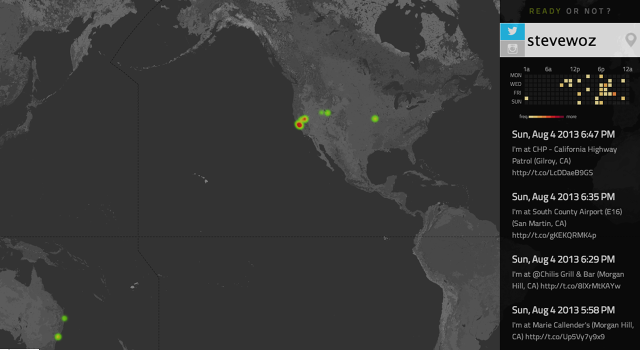
To illustrate, he points to Apple cofounder Steve Wozniak. “Now I know where he lives. He’s probably okay with that being open, but there are so many people who aren’t aware of what they’re posting.” Even Craigslist, known for its anonymity, can out a person’s address if uploaded photos contain geotags, Friedland added.
In addition to Ready or Not, the NSF grant included an educational component: a website that lists 10 principles for social media privacy. Some of its mantras include: “There is no anonymity on the Internet” and “The Internet not only duplicates, it never forgets!”
Though the privacy project targets high school students, Friedland said it aims to reach parents as well?after all, it’s their homes that are at risk of being cybercased. “Sometimes parents might panic a little too much or not care, but we want to make sure people make an informed choice about their privacy settings.”
The app shows how people could use your social-media posts to find you in the physical world. It uses GPS data attached to Twitter and Instagram posts to create a map of where someone’s been posting from recently.
Try to find yourself, your friends, or your favorite celebrity! Where are you most likely to be at 2:00 on a Tuesday?
Then follow the links and find out how to keep your social-media posts from giving your location away.
Disclaimer: This is an educational tool. It gathers publically available data and presents it graphically, to demonstrate the dangers of oversharing location data. While our tools don’t do anything that someone who meant harm couldn’t do anyway, using any one of a number of pre-existing tools that gather geotagged data, we sincerely hope no one uses our tools for anything other than educating themselves and others about the importance of protecting themselves from the potential damage or harm that could be done using any of those tools.
Sources: FastCompany, Ready Or Not